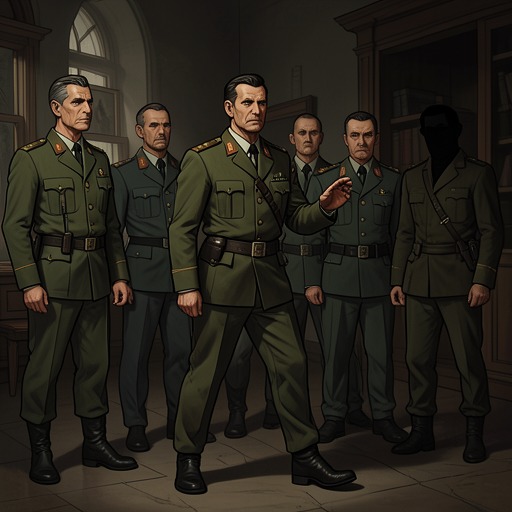
Edgar Allan Poe’s unauthorized officer impersonation
The Pale Blue EyePoe’s unauthorized officer impersonation at Kemble’s gathering turns a clandestine attempt to remain with Lea Marquis into a public test of loyalty, exposing both his willingness to defy military authority and his readiness to shield Augustus Landor. The discovery coincides with news that another cadet has vanished, shifting Captain Hitchcock’s attention from Poe’s breach of decorum to the investigation—and ultimately ending Poe’s role as Landor’s agent.
Causes and Circumstances
Poe’s immediate reason for remaining in disguise is personal: when Landor urges him to abandon the performance, Poe answers that he will not abandon Lea on the first night they have spent alone together. He insists that he will stay whether Landor helps him or not, making his choice explicit as an act of attachment rather than a mistake he intends to undo. His refusal to leave also means accepting the risk of appearing in a uniform he has no authority to wear.
Asked where the uniform came from, Poe says Lea gave it to him and that it had belonged to a dead uncle. He regards the garment with apparent unfamiliarity, as though only then noticing it on his body, before trying to redirect the moment by asking whether it fits him. The explanation links the disguise to Lea while leaving its precise history in Poe’s account; the scene establishes what he says, not independent confirmation of the uniform’s provenance.
The disguise acquires a second significance because Landor has recently found a bloodied square of cloth in Artemus Marquis’s closet. At the encounter, Landor runs a finger along a corresponding square on Poe’s coatee, but his finger comes away clean. The difference is concrete, yet the scene does not resolve the larger question of the cloth’s connection to the investigation. Instead, it places a potentially incriminating object beside Poe’s unauthorized appearance and lets the mismatch remain visible.
Discovery and Response
Captain Hitchcock arrives at Landor’s study still cloaked, his boots rimed with ice, and finds Poe attempting to slip away into the darkness. His entrance converts the private encounter into an official reckoning. Rather than immediately dismissing Poe, Hitchcock remarks on how well the uniform suits him and calls the episode an ingenious entertainment devised by Poe and Landor. The apparent lightness of the comment is sharpened by the fact that Hitchcock has caught Poe in an unauthorized role.
Poe steps forward and bows his head. He then insists that Landor had nothing to do with the impersonation and was as surprised and dismayed as Hitchcock. Poe accepts the blame as his own initiative and says that he deserves the consequences. His defense matters as much for what it does between the men as for what it says to the commandant: Poe places himself in the line of discipline to protect Landor from being implicated.
Landor’s response to Poe’s intervention is not presented as a settled judgment or a speech of gratitude; the scene moves on before such an exchange can occur. Hitchcock says he is in no mood to administer to Poe, because he has more important business. The change in priority is decisive. The same commandant who has just noticed the disguise now brings an urgent development into the room, in Poe’s hearing, rather than sending him away.
The Vanished Cadet and Its Consequences
Hitchcock reports that another cadet has vanished while Landor has been availing himself of Kemble’s hospitality. Landor is so taken aback that he barely attends to the words themselves; what registers is that Hitchcock is announcing the disappearance in Poe’s presence. The commandant’s usual rules of decorum seem, to Landor, to have been swept aside. The urgent news has displaced the question of the impersonation, at least for the moment, and Poe is permitted to remain as a witness to the investigation’s new turn.
That reprieve is temporary. After discussing the missing cadet, Hitchcock tells Landor that he can no longer consent to Poe serving as his agent in the affair. Landor objects that Poe has helped make substantial progress, but the decision establishes a boundary between his investigative partnership with Poe and the commandant’s authority. Poe’s actions have therefore produced two consequences that pull in different directions: his loyalty earns Landor protection from blame, while his unauthorized conduct results in the end of his official investigative role.
Narrative Significance
The episode sets private devotion against institutional discipline without making either disappear. Poe’s stated determination to stay with Lea explains why he accepts the danger of the disguise; his immediate effort to clear Landor shows that attachment also governs his conduct toward his investigative partner. In the instant Hitchcock discovers him, Poe is at once a cadet out of place, a man unwilling to leave Lea, and an ally willing to accept blame.
The scene also makes the uniform an unstable sign. It presents Poe as an officer to Hitchcock’s eye, but the role is unauthorized; it is associated with Lea through Poe’s explanation, yet its connection to the bloodied cloth in Artemus’s closet remains unresolved. Hitchcock’s description of the incident as entertainment briefly frames the transgression as a performance, only for the disappearance to expose how little room the investigation has left for play. The masquerade ends not with a simple punishment, but with a changed arrangement: Poe has defended Landor, and Hitchcock nevertheless removes him from the case.